Showing posts with label reading. Show all posts

Saturday, March 15, 2014

Looking for Mandarin 'companion'

A few weeks ago I was approached by Jared Turner at Mandarin Companion with the offer of a few download codes, giving me the opportunity to review* some of their new books. MC launched towards the end of last year, with the goal of releasing a series of graded Mandarin readers ("new books for a new generation of Chinese learners") - and they have a growing library available. Also in the MC team is John Pasden (of ChinesePod fame).

TL;WR**:  I'm very impressed.

Extensive Reading
I've read many articles about language learning that encourage you to start reading in your target language (books, magazines, newspapers, comics, …) as soon as possible for maximum gains. Of course for many other languages, it's relatively easy to do this - even quite early on. After all, they use the same alphabet as English, and there is certainly a lot more overlap with English. (For example, can you guess what the Italian word 'aeroporto' means? Or the German word 'Banane'?)

But for Chinese, it's tough to follow this great advice about extensive reading. Even before you can begin you need to have memorised a few hundred characters just to hope to understand the first sentence. And this is where graded readers come in ...

Graded Readers
("this rare hit title uses just 10 letters, as a rule")

You can read more about what Graded Readers are (and why they are good) in Mandarin Companion's own words, but suffice to say that they are books which are written to be at a specific level - allowing for the number of characters used, the level of the resulting vocabulary, the themes covered, etc. 

Over the years I have tried a few graded readers, and collected a number of Chinese books at various skill levels. The problems I have had is that some of the books have been too simple, some have been too complex, and many at the more basic literacy levels have quite boring stories - even childish.

The Mandarin Companion books that I have read are different, and I thoroughly enjoyed reading them.

So, the books …
I was given download codes for the following three books:
  • The Monkey's Paw (originally by WW Jacobs in 1902)
  • The Country of the Blind (originally by HG Wells in 1904)
  • The Secret Garden (originally by Frances Hodgson Burnett in 1911)
These are old stories - but don't let that put you off. I'm guessing the reason for choosing old stories is to avoid issues around copyright, but these are classics - and are very good stories in their own right. A nice touch is that the names and places have been changed to totally 'Chinify' the story, so you forget about the Western world for a while.

In fact, I was so immersed in reading them that I often forgot I was reading Chinese, I was just so into the story - which is how reading should be IMHO.

These three books are all at the so-called Level 1 - which means they use about 300 characters, which build up to 400 unique words. But because the stories chosen were classics, I didn't feel that I was reading children's books - even though my reading skills are materially past Level 1. 

A nice touch was that for certain words which were perhaps deemed to be more challenging for people at Level 1, there is a set of endnotes - you can click on the words to go to the definition, and then click 'return' and get taken back to the place you left off.

And I was pleased to see that people's names and places were underlined. I seldom see this in the Chinese books I read - most commonly seen in movie subtitles - but it's really helpful, particularly for readers who are less experienced.

You can see their full selection of books here.

Suggestions to Mandarin Companion
Although I very much enjoyed reading their books, I have some suggestions for them - one bigger, and several smaller ones.
  • I do have some concerns with the price - at fractionally under US$10, I think it could work out to be an expensive habit. On the one hand, I appreciate that a huge amount of effort goes into abbreviating, translating, illustrating and then grading these books - and maybe this really is the 'right' price. On the other hand, I believe that books for learning like this should be consumed and not savoured, and for something that takes an hour or two to read (depending on your level), even a book a month will amount to a lot, let alone anything more regular.  (At first glance, $10 for around 120 pages perhaps doesn't seem so bad, but allowing for English introductions & endnotes, the stories are only about 70-90 pages including illustrations.)
  • The endnotes are great - but I think a new word really only needs to be referenced once. For later appearances of the same word, I think MC could (indeed, 'should') skip the endnote reference. That would certainly make the reading flow better.  For example, having the endnote break 漂亮的 into 漂亮[2]的 each time, 盲人门 into 盲人[1]门 dozens of times, and 盲人国 also into 盲人[1]国 dozens of times feels a little clumsy and slow.
  • I think that having an illustration that represents the end of the story should be avoided (or put waaaaay past the final page of text). I was down to the last couple of pages and staring at me was a picture of what happens at the end - even before the words had taken me there. I had a sense of pride for having read the book, but it wasn't the words that gave away the ending it was the picture :(
  • There are a few places along the way where a name was missing in the intro, or the 'return' from endnotes took me back to the wrong page. Not serious issues - just requires a little more editing.

The Future
  • I look forward to seeing more titles being released. I will be reading more at Level 1, partly just because I enjoyed the flow of reading at a level that didn't require any thinking or use of dictionaries, and partly because the stories are just good reads. I also look forward to seeing titles coming out at the higher levels (I'm not sure when that might happen, or how far those levels will reach - perhaps MC can tell us below?).
  • Following on from my comment about price, maybe there will be special bulk offers available for people who want to mass consume? Please?
  • And as for you … I recommend that you get yourself a book or two - for instant reading on Kindle, iBooks or Kobo. They're great stories, nicely translated, and they make excellent reading practice. 
TL;DR**:  I'm very impressed and will definitely get some more


* Other than the three free download codes, no other incentives were offered nor taken
** 'too long won't read' or 'too long didn't read'  :-)

Thursday, January 31, 2013

Mando-lish-nese: the trilingual bookstore name

In the heart of Hong Kong's Causeway Bay (the shopping district with the highest rent in the world, higher even than New York's Fifth Avenue, and double that of Tokyo's Ginza district), I saw this book store:

... and the name of the place really intrigued me. You can see it better here:


If I were to tell you that the English name is derived from the Chinese name, would you believe me? Possibly not, so let me take you through my logic ...

  • 樂文 = Luck-Win  (In Simplified characters it's 乐文, but ignore that for now - this is HK)
  • You probably know 樂 from 快樂 (kuàilè = happy, S=快乐) - and 樂 by itself means 'happy', not 'lucky'
  • Similarly 文 is from 文化 (wénhuà = culture), and 文 by itself means 'culture' not 'win'
So what's going on?
  • The first clue is that 文 is pronounced wén in Mandarin, and that sounds exactly like 'win'
  • But that hasn't solved the problem, because 樂 is pronounced 'le' and not 'luck'
  • So now we leap across to Cantonese, where 樂 is actually pronounced 'lok', and yes - that does sound a little like 'luck'
So I thought that was cute - like many Chinese brands, the name of the book store is so positive (Luck-Win), and actually the English name can be derived from Chinese ... but not from the meaning of the characters, only from the pronunciation.  And even better than that, one comes from Cantonese pronunciation, and one comes from Mandarin pronunciation.

I think my next project will be an online Mando-lish-nese dictionary. Clearly there is need for something like that :-)

Sunday, July 15, 2012

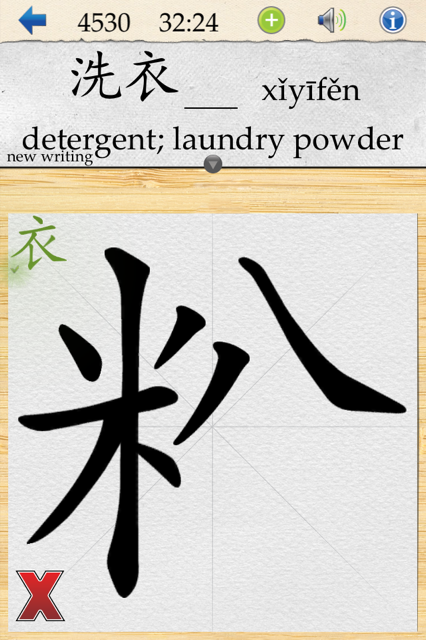
"Write on!!" - reviewing Skritter for iOS

Before the official release of the app for iOS, I was approached by the Skritter team to test it, and perhaps write a review. I wasn't offered any freebies, and was given total freedom to write my own review, so I'm comfortable that this is a neutral perspective.

Also, while it was tempting to publish my review around the time of the official release when all those other reviews were being published, I was worried that I would write it more in light of my excitement of having a new novelty toy to play with. I was more keen to actually get a sense of the 'longevity' of Skritter for iOS ... how long before the excitement died down?? (Hint: It still hasn't)

For no particular reason, I'm going to write this review in the style of a FAQ. (By the way, if you are rushed for time, just read Q1, 4, 6, 7, 13. Oh heck, just read it all - this isn't a particularly long post :-)


1. Would you recommend Skritter iOS to others?
Yes

2. Will everyone benefit from using it?
In theory, yes.  But I think there are plenty of Chinese learners who should be focusing more on pinyin, vocab acquisition, tones, and listening skills - and Skritter should perhaps wait a little longer.

3. What about the iOS experience?
From an iOS point of view, the implementation of Skritter is fantastic. It's sleek, artistic, fast, powerful, flexible. It's a great example of using iOS to the full.

4. Did you use Skritter before testing the iOS app?
No. In fact, I had a completely wrong idea about Skritter, so I never bothered before!
I'm glad I took the time to play with it. For example, I had assumed it was just about learning to write characters, but actually it's much more than that. Yes it can be used for that, but it has an amazing selection of vocab, so that it goes way beyond individual characters, into compound-words, phrases and sentences.

5. Does Skritter iOS cater nicely to people who haven't used the website before?
In some ways, Skritter is intuitive to use. But I think the team could do a little more to help people who are totally new to Skritter. For example, there are many settings in the preferences pane that I'm not sure what they actually do - a clarification sentence would be nice for each. It talks about numbers of items added, number of items synchronised, etc. - but it wasn't obvious to me what the difference is. I remember having to add characters one at a time, up to a hundred at a time, although I really wasn't sure why I was having to do that when I had already selected a list - shouldn't it just add the whole list?

6. For actually learning characters, would you recommend Heisig or Skritter?
I still believe that the Heisig method is a better way to learn characters (either reading or writing) than practising writing (on paper, in the air, or with Skritter). I strongly recommend that Heisig should come first, and then Skritter should follow. And yes, definitely use Skritter once you can read & write characters.

7. If you already can read/write through Heisig, why bother with Skritter?
Ah, well this is where I'm finding Skritter to be particularly amazing.
I believe Heisig is the best way to learn to read & write - certainly the fastest with least effort. But it doesn't teach you the pronunciation (pinyin), nor does it show you the characters being used in compound words. I'm finding Skritter to be an excellent bridge between the Heisig world, and the practical world of reading and writing more significant texts. Highly recommended.

8. What's your biggest concern about Skritter iOS?
I think I'll say it's the cost. I don't doubt that a huge amount has been invested in developing this great app, but at just under $10 per month, that's a huge investment, even over a year. I think a lot of people will be excluded from signing up at this price (even the discounted prices), and I'm curious to know whether I'll still be happy to be paying this before a year is up. In a world where apps cost a few dollars, this is on the other end of the scale.
I will say that the Skritter team are not trying to trick you to paying them money, though! As my trial period was ending, they sent me quite a few emails warning me that I was going to start getting charged. No one could claim they were charged because they forgot to cancel, by mistake. Well done Skritter.

9. Any technical thoughts about the app?
There are some strokes that Skritter keeps saying I'm wrong, even though I find myself writing perfectly over the hint-line, mostly commonly 阝 and many near-vertical lines. Odd. I'm inclined to believe it's my handwriting and not Skritter, but when my lines appear to overlap perfectly with the underlying hints, it makes me wonder.

10. Do you like the font that underlies Skritter?
Actually yes, it's a beautiful font - lovely. I do wish however that we were given the option of a second font - something that was a little more computer-perfect. Most of the characters I see are of course on a computer, and Skritter's font is slightly more stylistic. This means I find myself positioning/angling some of my strokes in ways I would expect based on what I see most of the time. From memory, characters like 火, 垂, 民 all are slightly different as a computer font than the Skritter font. This means either Skritter thinks I'm wrong at times, or it ends up moving my stroke far away from where I placed it. I can learn to live with just one Skritter font, but a less stylised one might be a nice option. One day.

11. What about Skritter as a flashcard app?
Well, it is sold as an SRS (spaced repetition system), but so far it doesn't feel like that. Maybe there is a setting I haven't used yet, but very few characters have come up a second time, I still seem to be working my way through the list, one phrase at a time. And although it tests my pinyin & tones & definitions, it feels like only 1 in 25 cards is non-handwriting. I'm still waiting for the 'repetition' to begin, let alone the 'spaced repetition'.

12. What extras would you like to see?
Firstly, I've simply added words from two lists: "Integrated Chinese 2" and "Business". And Skritter seems to have thrown these into a pot, deciding for itself which characters to feed to me when. Sometimes (particularly on a plane, flying somewhere for a business meeting) I feel like I'm in "business mode", and I'd like to learn words only from the Business list, but I can't do that.
Secondly, it would be nice to have a search facility. As I mentioned above, the character 垂 was different, if I remember correctly, to how it appears on the computer. But I can't search for a single character within Skritter in order to show you how it looks. Also, sometimes I remember struggling with certain characters, and it would be nice to find them again to practise, but I don't seem to be able to do that on the iOS app.
Thirdly, when trying to decide which lists to use, it would have been nice for the list description to include the number of characters that I'd be getting by selecting that list.
Fourthly, the app is really feature-packed, and it would not surprise me to find out that all the things I think need to change are already a part of the app - maybe I just don't know how to do it! :-) (For example, at one stage I thought a nice option would be to retain my stokes, rather than replacing them with the right strokes - but then I discovered there's a setting for that!)

13. In the opening paragraph you spoke about concern about the excitement of using Skritter iOS dying down ...
Yes, that was a real possibility. I've used many tools and websites to improve my Chinese; I've started listening to many podcasts - but over time I find I get bored of them, and just realise one day that I don't use them anymore. But so far Skritter has been really good, and I continue to enjoy using it. It's a nice distraction when I have a couple of minutes to spare, it's a nice break from podcasts, or Heisig Book 2. And I have definitely got value from using it.

So I am still using Skritter iOS. And I am still benefitting from Skritter iOS. And I am still happy to continue to pay for the Skritter iOS app.


tl;dr: If you can afford it, then I think you probably should use it too.

Write on!!

Thursday, May 24, 2012

Bad Heisig images & great Dali paintings

Discovering (un)treasure

It was about 2.5 years ago that I finished studying Book 1 of  "Remember the Simplified Hanzi" Heisig & Richardson. And as you might have seen from a relatively recent post, I've got Book 2 staring at me from the shelf ... but first I wanted to completely re-do Book 1, to make sure that I revised all primitive images, and was truly ready for the next installment.

In order to revise the book, I downloaded the Anki database of the book's 1500 characters, set it to 10 new characters a day, and just ran it from there. That happened nearly 150 days ago ... So I'm just a few dozen characters away from finishing the book. Again.

The database is pretty good, with the character number, hanzi, keyword, pinyin ... and it also contains stories (where Heisig & Richardson didn't provide their own stories). These stories appear to have been taken from a community effort to create stories for those characters that didn't get their own in the original book. I guess anyone would have been able to contribute their own story for a character, although I'm not sure how they chose which was the one to get into the Anki database.

Much of the time, I just stuck the the story that I had previously created myself, but every now and then I couldn't remember mine, so I looked at their stories. Some were actually quite good, but so often the stories left me scratching my head.

"The Persistence of Memory"

In this article, I have taken an extract of stories that I found in that Anki pack, and highlighted some of the ones that I don't like.

Of course, for the most common characters, you see them so often that after a while you forget the story and you just know the character. And that's OK. But there are some characters which I have barely seen since completing the book, and when I do see them sometimes, I do have to rely on the stories - and that's when the persistence of memory becomes important.

And this is going to be even more important for Book 2, I'm sure, given the even further reduced frequency of those characters.

This is not about personal preference of whether it's 'nice' - this is based on my being able to work through Book 1 in about 3 months, and seeing what did & didn't work. It's also based on now revising the book after 2.5 years, and noting which of my stories persisted, and which completely failed me after all this time.

No offense intended

It's possible that you were the author of one of the stories I have included below. No offense. But I think it might be useful to consider what makes a good story, and what is likely to give problems. And for anyone that thinks I've got it totally wrong, please leave some comments below ... I promise I won't be offended :)


The Hall of the (in)famous


760: 微: Tiny
The tiny sherpa (taskmaster) is leading this queue of brave ant mountaineers up the wall of the house and towards the ceiling where they can live in peace and security in the attic. Unfortunately, they didn't account for the strong winds that blow through the attic at that altitude, so they are all swept off the mountain (a wall) and back to the ground!

Two thinks go wrong, in my opinion:  Firstly, the story has too many 'equivalents' to be memorable: You have to remember that taskmaster is a sherpa (which may differ from your other taskmaster images), and a wall is a mountain - so when you see the image in your mind, will you remember to use a mountain? Or will the image of 'wall' arise and confuse you?  Secondly, there are too many extra words here, that are likely to confuse: house, ceiling, ground. These all have their own primitives, and this interferes with how the image persists in your memory.


950: 碌: Commonplace
Stones are commonplace - stone snowmen, less so!

Unlike the story for 'tiny', this one is simple with no additional confusing words. Good. But consider these two alternatives ...
 - Metal is commonplace - metal snowmen, less so!
 - Wood is commonplace - wooden snowmen, less so!

As you can see, although going from story to keyword might be possible, if you go from keyword to story, suddenly the requirement that the word is 'stone' fades, and you may not be able to remember what is the primitive on the left. Try to make the 'stone' more integral to the story.


951: 争: Contend
This drunkard has to contend with crossing a booby trapped lawn back to his house. First, he keeps stepping on rakes in the grass (which fly up and hit him in the face) and secondly he has to avoid getting bound up in the tough hedges all around.

Again, lots of extra words in the story to confuse which primitives should appear, like house & grass (which have their own primitives). Secondly, do you think you'll remember the word 'contend' when seeing the character? Or will you see the 'bound' and the 'rake', see the guy sneaking through the garden, and wonder if the keyword is 'careful' or 'dangerous' or 'injury' or ... 'contend'????


991: 乏: Weary
Zorro has become world-weary, having seen one too many drops of cruelty in his adventures.

This feels like a sentence and not an image. How do you visualise this? Will you still have memorised the phrasing of this sentence in two years time?   "drop of cruelty"?  I just believe that stories should be more clear, more explicit, less wordy, for them to persist in memory.


1036: 泻: Diarrhea
Diarrhea flows out like water, writing off the meal that you ate last night.

Yes the primitive on the right is 'writing', and in theory 'writing off' matches that. But as with the previous story, this would only work if you memorise the sentence. It's not an image, and it's unlikely to be remembered for long enough to be useful. I would really recommend your image either includes someone writing, or seeing writing on a page ... something that is visually memorable. And try be consistent: if it's someone writing, then always see someone writing to represent that primitive.


1157: 饭: Meal
At mealtimes you eat your food against the backdrop of a TV episode or some other entertainment. Mealtimes are the only things that will drag you out of contemplation of that idea that has been eating you up!

I don't even know where to begin with the confusion this image creates. Again, it is built on being able to memorise a sentence ("drag you out" - rather than seeing something being dragged;  "against the backdrop" - rather than seeing something against something;  "eating you up" - rather than someone actually eating). You are making it really hard for yourself if your images are based on memorising sentences, rather than picturing images that stick in your mind.


1178: 脑: Brain
The brain is the only part of Fagan's flesh this is worth anything - every other part of his flesh is cruel, despicable and nasty - from his top hat down to the pit of his stomach.

Double-counting! On the left is 'flesh' and on the right is 'Fagan' - thats is enough for a story.  Yet this one also includes the components of 'Fagan' (being 'hat' & 'cruel') - which is confusing.


1212: 请: Invite
You invited a few friends round for some drinks at your house, but the words got out and telescoped out of control! Now you have a full blown house party going on, and none of your words are helping to move the resulting mound of grown-up flesh from the house.

I'm sure by this time you're seeing that certain problems keep arising. Firstly (yet again) we have too many words ... drinks, friends, house, etc. Careful these don't confuse the image when you have to piece it together yourself. And secondly, it feels like trying to memorising a sentence again!  "telescoped out of control"?  "mound of grown-up flesh"?   Even if you see a wild party in your image, how will your mind remember "telescoped out of control"?  Can't you actually put a telescope into the image?


1252: 陈: Exhibit
The museum is showing off the pinnacle of Eastern transportation development. Forget Hyundai and Toyota - the humble rickshaw is the most amazing invention that they are exhibiting!

This takes the use of 'pinnacle' and again makes it wordy, rather than visual. In my mind I always use an image of the top of a certain famous building in London as 'pinnacle' - and any scene that takes place here will be obvious to me to use that primitive on the left, simple. And if you're thinking of this story/image, how will you remember to use the word 'pinnacle', and not 'top' or 'peak' or anything else?


1275: 决: Decide
"You Decide" - at least, since the last king had his head cut off by a guilllotine! Of course, given how effective democracy has been it would have been wise in restrospect to keep the head on ice to make decisions for us when the politicans are caught up in squabbling. Alternatively, this pictures someone who can't decide between two model of guillotine: extra tall or extra sharp? While he waits his feet are getting frozen to the ground in the cold air.

There are actually two version here. The first one has the added confusion of a head (careful not to use it as a primitive), whereas the second has the ground, which also isn't one of the primitives in the image. I'm not sure the link to 'decide' in the first one is obvious enough to be memorable.


1318: 蚊: Mosquito
Mosquitos are principally found in Scotland, where the insects bother the highlanders to their hearts content.

Heart's content? So there is the heart primitive in the image? No, so careful about using the word 'heart' :-)  And how does this story help you differentiate between mosquitos? Flies? Birds? All could work as it appears - but only one is right. Make sure your image involves them sucking blood - so it's clear this is a mosquito and not a fly.


1343: 遗: Bequeath
Bequeathing your possessions to your children can be an expensive road to go down, due to inheritance tax. Much better to spend it all before you die!

I feel I'm repeating myself here, so I'll stop after this one.  You can't visualise "road to go down" - not in the way it has been used in this story. Really try to be more explicit about a road, like having all your expensive possessions lined up along the side of the road, so you are in effect bequeathing it to anyone who wants to help themselves to something.


A Better Way

Ultimately this article is just to get you to think about what makes a bad story, to make sure you don't make these common mistakes. Trust me - you want these stories to last!

Here are some of the other posts I have written on making great images, so that you can succeed in learning to read Chinese ...
With a clear set-up, images that do the right things (as per the links here), and which don't do the wrong things (as with the examples in this post), you are ready for visuals that will last, that will take advantage of the Persistence of Memory.


Good luck!  And let me know below if you disagree with my assessments - it would be interesting to hear from you. (And yes, you can even comment if you agree with my post!)

Sunday, March 18, 2012

Heisig 2 ("Please sir, I want some more")

Well, Heisig (Book 2) is out - both for simplified and traditional characters. I have a copy - it feels great in my hands.

The home of the Heisig & Richardson books is at the Nanzan Institute (and here is a direct link, without having to navigate the menus).

First impressions
Its' funny - people imagine language learning to be such a pain, but I felt like a child at Christmas unwrapping a present. I couldn't wait to page through it.

First I went to character number 50,001 - which I had heard about. That was fun. And what a story! Then I read the introduction, and discovered the book was designed that it could be learned in conjunction with Book 1.

(Aside: For now I think it's better to do Book 1 before doing Book 2. After all, x characters a day is x characters a day, why bother flipping between books? And additionally, Book 1 has the 1000 most common characters - may as well focus on them first. IMHO.)

Not surprisingly, the characters in Book 2 are generally more complex than Book 1 - which really isn't a surprise, but it struck me while paging through the book that it was going to take quite a bit more effort to get through Book 2.

But I am looking forward to beginning with the middle to reach the end.

Preparing to begin in the middle to reach the end by re-beginning the beginning
Many of us have been waiting for a while for this. It has been interesting to watch how different people have coped with the delay before Book 2. Some people started off as huge fans of the Heisig approach, and once finished as time wore on they started picking fault with the approach. Sigh. Others decided they couldn't wait and started using other books that would take them further than 1500 characters - which I would find extremely confusing as stories start over-lapping and contradicting.

So I waited.  (I've got so much other material it was like the lack of Book 2 was holding me back.)

When it finally became clear that the time for publishing was 'soon', I picked up my Book 1, and started working through it from the beginning. I knew I had forgotten a fair share of characters from Book 1, and without doubt although I might know what a character means now, I would certainly have forgotten some of the images & stories. And of course I would need the keywords & stories for Book 2!

I figured I could manage 10 characters a day (including revision time of previously-learned ones), without impacting on all the other things I had to do, so that was my goal. Yes, 150 days to do Book 1 seems a lot, but I really didn't know for certain when Book 2 would arrive, so I was OK with that.

I am now 800 characters in, and enjoying Book 1 properly. Book 2 is waiting patiently but that's OK. It's clear that over the two years since I finished it originally, revision was definitely due!

Anki to the rescue
I've written quite a lot about flashcards, and Anki in particular. Naturally, I used Anki here too. I loaded up the free Heisig (Remembering the Hanzi) deck, and set it to 10 cards a day. As mentioned above, today I finished 800 characters, and I'm on track to finish on exactly the day I targeted.

For those who care about the details, this is my process:

 - read each day's 10 characters from the book, to get the keywords and background (and stories, when they exist)
 - 10 new characters a day, no more no less - plus as many need revising according to Anki's SRS
 - during the day, I will go through the flashcards: the new ones and the others which have come up for revision by that stage
 - if I really struggle with a character when it comes up, I might press the [soon] button to get it back to the front of the queue
 - I normally have a total number of cards of around 40-60 (including new ones) each day to review, which takes 10-15 minutes during the day - very manageable
 - I usually do it while walking to or from the office, or meetings - so in effect this takes zero time in my day :-)

And now ...
So that's it. I've noticed some interesting things about the Heisig approach, and I'll write some more hints articles soon.

Have any of you started Book 2? Or are you revising first, like me? And what about those still on Book 1 - what have you decided? Drop us a note below.

Saturday, September 5, 2009

500 - 'Little step' or 'Giant leap'?

If you're following my reading experiment, you're probably wondering how useful it is to know just 500 characters. And if you weren't already wondering that, then take a guess - is it a lot or a little?

They say (yes, yes - whoever "they" is) that you need 1500-2000 hanzi to be able to read a newspaper, and that children leave school knowing 3000-4000. So in that light, 500 doesn't sound like much, does it?

And yet, reading my new "Adventures of Tin Tin" in Chinese, I'm aware that I can actually follow quite a lot - so I thought I'd do a visual experiment to see how much 500 really was.

Because fiction & non-fiction are so different, I separately printed out one page from the book 小王子 (The Little Prince), and a page from the BBC's Chinese website. Then I highlighted all the characters which I had learned in the first 500 from Heisig's Remembering the Simplified Hanzi - and this is the result. (You will have to click on the image to get the full size version ...)


Even without looking at the larger image, you can see that a large proportion of the page has been highlighted. This shows you that even at only 500, you're able to understand a large proportion of the characters.
   
(And don't get too detailed, pleeeeease. I might have highlighted words that were after the first 500, or missed out words that should have been highlighted. Overall, the highlighting is very close to reality.)
   
Note however that Heisig introduces characters by building up patterns - and doesn't necessarily include the most common characters first. (That's OK - if you only want to learn the most common 200, for example, then Heisig isn't for you.)
  
So I then used my green highlighter to include words that, if you're learning with an open mind, you can't not learn these characters. This includes ‘I’ (我), ‘you’ (你), ‘not’ (不), ‘person’ (人), etc. As you can see from the image below, this adds quite a chunk to the proportion of the text you can read.
So if you haven't worked out the conclusion for yourself, at 500 characters (which only took me about 3 weeks to learn) - you can follow a massive proportion of the characters on the page.
    
But don't be mislead!  This is not to say that you can understand at least half the article - because you won't be able to. Chinese uses lots of compound words - so that even if you know the two characters which make up the word, you still won't get the word.
    
For example, on the second line of the Xiao Wang Zi text, you will see the word 地方 (dì ​fang). You will know from Heisig that 地=ground and 方=direction - "ground direction"? What?  Actually, ​​'dì ​fang' means 'place' - but you wouldn't know that if you had only learned individual hanzi from Heisig.
   
Actions for you ...

Greg

Monday, August 31, 2009

Reading (day 18) - 500 characters!

OK, its time to celebrate!  I have just crossed 500 hanzi in my "Learning to Read Chinese" experiment - in less than 3 weeks. 

This is an update on my experiment to learn to read Chinese. You can also read my original post on this topic, or check out all other posts on my experiment. After a bit of research I settled on Heisig's "Remembering the Simplified Hanzi" method - which is progressing really well.


Here are some of my thoughts on the Heisig method of learning to read & write Chinese:
  • If you'd ask me when I began, I didn't think I would get through 500 with 90%+ recall in just 3 weeks. But I have.
  • I'm not delusional - I'm pretty sure the next 500 will take longer. Especially because of the fact that as you learn more, you need more time to revise.
  • I'm enjoying this a helluva lot more than I thought I would. Although I was looking forward to this experiment, I thought it would feel a bit like school - but I am actually eager to get some quiet time to learn more.
  • The more you do this, the better you get at creating and remembering images.
  • I know there is nothing magical about 500. But I'm goal-orientated, and since Book 1 has 1500 characters, 500, 1000 and 1500 were always going to be important milestones.
And you know, at only 500 hundred, I'm neverthless seeing so much more meaning in Chinese texts. I can read sentences using words I've learned. And often, even when I don't know the word, I know enough characters that I can work out the general meaning.

And here's a really important point ... Heisig's goal is not to teach the pinyin pronunciation of words. But that's OK - I've got podcasts & flashcards to do that. All I'm trying to do here is to read words and know what they mean.

On a more technical level, here are some observations based on the characters I've learned since the last update:
  • In Lesson 17 I was getting confused between footprint, footprints, and footstep. I didn't realise at first that the images were going to be slightly different, so I used them inter-changeably. Fortunately, only a few stories down, I realised I had to be more clear, and was able to go back and clarify the images. 
  • I'm learning English words too! I never knew the word "ford" was a verb wrt crossing rivers, but found that out with 涉 (#381).
  • Again I found myself getting a little confused between the word's meaning, and what its image is when used as a primitive. (Heisig does this because some words are difficult to use when creating images.) 
  • For example, although 竟 (#487) means "unexpectedly", but this is difficult to use in images - so at such times you should use the visual of a "mirror". (This isn't as silly as it sounds - just look at the actual word for mirror:  镜).
  • I had a really sad moment ... 乞 means "beg", and I used a clear image of a prostrate begger with a hook instead of a hand (look at the image and see why). But the very next character is 吃 (to eat) - and the image naturally took the "beg" scenario and extended it to this crippled starving guy wanting to put food in his mouth. Such a depressing image!  (I hope I don't create an eating-disorder for myself as a result :-)
  • Characters #479-81 are 资, 姿 & 咨 - which are made up of 次 ('next') at the top and another primitive at the bottom. Heisig's suggested stories were not consistent in the sense that sometimes the top part came first in the story, sometimes second. I simplified this as "next shell", "next woman", "next mouth" - and had images which generated the words 'assets', 'looks' & 'consult'. (If you're not actually creating Heisig images yourself, this last point might not make a lot of sense.)
Revision is becoming increasingly important, so here are some thoughts:
  • I find it makes a big difference if I review my most recent lesson after about 12 hours (i.e. the next morning or the next evening).
  • The first time I revise a lesson, I work through the hanzi and - by recalling the story - remember the meaning. The second time I revise (a day later) I make a point of looking at the English word and - by turning the image into a story - create the hanzi. Both are important.
  • As I progress, I make a point of mentally re-creating the stories for primitives that are being used now, although they were taught much earlier.  This keeps up my recall.
  • I am aware that sometimes, especially when a character is built on the previous character, I know what word is coming next even before I see it. So I've been trying to revise in later sessions by bouncing around from chapter to chapter, page to page - to avoid this familiarity. But it's reached the point where I've got to start using flashcards. Anki ... here I come.
  • Over the next few days I'm simply going to review these 504 characters. It will give me a chance to confirm my recall, and make sure my foundations are strong because the connections are becoming more advanced.
This habit of decomposting hanzi into their components is becoming automatic - and powerful:
  • For example, this morning I saw (for the first time) this character: 做.  
  • I knew that 故 (#342) means 'deliberate' (you don't want to know the image I use for this one!), and that 亻 means person. 
  • A 'person being deliberate'? I guessed it might mean either 'do' or 'make' or something like that - and it turned out the definition is indeed 'make'.
  • So I was able to follow the sentence using a word I'd never seen before - and now I'll never again forget how to read/write the word for 'make'.
  • (Have I mentioned before that I'm liking the Heisig approach?)

So if you're sitting on the fence about whether you should use this approach, I have a strong yes recommendation.

Here's an affiliated link to the books page at Amazon:
Remembering Simplified Hanzi: Book 1, How Not to Forget the Meaning and Writing of Chinese Characters


So here's to the next 500!  And I would appreciate your thoughts too - whether you're a fan or opponent of Heisig, and especially if you have observations or suggestions to share, please leave a comment ...

Sunday, August 23, 2009

Learning to read Chinese (day 11) - great progress

This is an update on my experiment to learn to read Chinese. You can also read my original post on this topic, or check out all other posts on my experiment. After a bit of research I settled on Heisig's "Remembering the Simplified Hanzi" method - which is progressing really well.


As of last night, 11 days into the experiment, I have finished lesson 14 - taking me to a total of 336 characters. My recall is around 90% - although I'm going to do a full review session later today, so I'll get a better idea of whether I'm lying to myself.

On average I'm doing about 20 minutes a day, learning about 15 new characters every day.

Some of my technical observations from the last week are:
  • Normally the best time for me is last thing before I go to sleep - because recall the next morning seems strongest.
  • I found lesson 11 a bit 'abstract' so I was trying to be as visual as I could. Unfortunately, this was just before bed-time, and I spent the night dreaming about Chinese! In my dreams I was trying to memorise, trying to recall - and getting stressed. I woke up very tired!
  • I'm finding the Heisig-method visualisations very powerful in differentiating between some hanzi which look very similar - like 犬 and 尤
  • I'm learning not to deviate from the method! For example, this is the character for cry: 哭. I didn't bother constructing a "story" for this because I could see this looked like someone crying. Simple. Unfortunately, when I tried to recall it during a revision session, I was trying to remember the story that links the 'primitives' of the word - not remembering that I'd bypassed that part. OK, always use the story from now on!
  • I already knew the character 高 (tall) - so I was a bit lazy in constructing the story. A couple of days later I realised I could not write it - even though I would easily be able to read it. Again, I'm learning that I shouldn't deviate from the formula.
  • I twittered this a few days ago: "Going to try clarify in my mind difference between 'same', 'uniform' and 'equal' - so I don't confuse 同 匀 & 均 with my Heisig visualisations"
But what about my actually ability to read? Well, I'm surprised at how much just 300+ characters can make a difference. For example:
  • I jogged past my local Chinese restaurant the other day, which I simply know as "Royal China". I had previously (a year ago?) tried to memorised the Chinese name (皇朝) - but I had zero recall. This time I immediately recognised the characters, the story, the meaning. Flawless.
  • I went to MandMx where they have great cartoons in English & Chinese, and looked through the collection of food cartoons. From not being able to read much of anything a few weeks ago, to generally being able to follow the meaning (obviously there were holes in my comprehension) is a huge success. Feels great.
  • Was looking through some old notes written in pinyin - and suddenly they looked so plain! Where were the Chinese characters ... tsk tsk. I guess this means there is no going back.
So at this point I'm still really pleased at my progress. I know that the more I learn, the more time I'll have to spend revising. But at least I'm not having to write characters 100 times - that never worked for me.

Don't forget to subscribe to Mandarin Segments, to keep an eye on my progress. And I look forward to some comments & suggestions from you.

Saturday, August 15, 2009

Learning to read Chinese (day 2)

I've been thinking a little more about Chris' comment on my previous post, and I thought that an example might help explain why I'm still excited about this.


Today, using the Anki flashcard system, the word for razor came up: 刮胡刀 (guā hú dāo).

Normally the odds of remember that word would have been low. Very low. I guess in future I would have looked out for a three character word which ends in 刀 (dāo=sword) and thought of 'razor'.

But immediately I noticed that the middle hanzi (胡) was one I'd already learned a couple of weeks ago (RTH #17) - which means "reckless".

The book had taught me that the first primitive looks like gravestone - and means 'ancient' (create your own image here), and that the second means 'moon' (ditto). In my mind, "ancient moon" makes me think of the ancient werewolf curse - thus "reckless" (I'm sure you can picture a werewolf going all wild & reckless, right?).

So now I have a three-hanzi word where the middle is 'reckless' and the last is 'blade'.

I haven't learned the first hanzi (刮) yet, but I looked a little closer ...

I can see it's made of primitives for 'tongue' (RTH #40 - which I already learned), and 'sword' (RTH #83). Since the dictionary tells me the overall word means 'scrape' - it's easy to remember a sword being used to scrape the tongue. Ouch!

So, although it looks like a complicated process, it took less than a minute to associate those three hanzi with 'razor' - and I doubt I'll forget them.

And if you know some of the 'primitives' I've used in this comment, there is probably a very good chance you're not going to forget either ...

... scraping the reckless growth with a sword ...

Razor. (Simple, yes?)

I hope that helps you understand my thoughts. (It certainly helped me solidify them by writing this out!) I can easily recall characters, and remember characters, and now even remember more multi-character words.

I'm looking forward to day 100!

Thursday, August 13, 2009

Learning to read Chinese (day zero of a personal experiment)

I'm going to do an experiment, and I'm going to document it here.

Until now my focus on learning Chinese has been conversational Mandarin. Since my last trip to China in May, I realised that my next challenge was going to be learning to read Chinese. Properly. Sure, I had picked up, say, 100 characters by then without even trying, but I wanted to be able to read signs, newspapers, etc.

So I've spent a bit of time reading up on various methods of learning to read, and eventually I've chosen one to focus on. In future I will log my efforts and my results.

Context

I don't live in China, so I don't need to be able to read Chinese. This is a personal goal - and I know that life is likely to get in the way, often. If it comes to limited time availability to learn, I'm going to choose conversational Mandarin over reading.

I work really long hours, so I have limited time to learn Chinese. If I progress slower than you think I ought to be progressing, don't let that stress you. If you spend more time than me, and that's your goal, then you'll progress faster than me.

Is this really day zero?

Yes. Well no, not really. These are the reasons why not:
  • I already knew about 100 hanzi before I began
  • in experimenting with different systems, I learned 94 new hanzi - just to check that I liked the approach
These are the reasons why it is day zero:
  • I will not judge myself by whether I simply know what the word means (for example, 中 is easy), but by whether I know the "story" associated with that character, so that the past doesn't matter
  • the approximately 100 characters I knew before I began this experiment are not the first 100 in my book, so it's not really a 'chunk' of advantage
"Remembering the Hanzi"

After trying a few methods (I'll write about this in a later post) I decided to learn to read using the approach taught in the book called "Remembering the Hanzi" ("Remembering the Simplified Hanzi 1", actually).

You can see the books' homepage here, and you can download for free the first 61 pages of the (simplified) book here. In summary, though, the key points are as follows:
  • it was originally a system for learning Japanese Kanji developed 30 years ago, but was only adapted for Chinese hanzi in 2007
  • book 1 covers 1500 hanzi, with another 1500 covered in book 2
  • the system does not teach the pinyin of the hanzi (and so you won't know how to pronounce it), it rather teaches a method of association for seeing characters and immediately identifying the meaning
  • it starts off creating a 'story' or 'visual image' for basic characters, and then builds these 'pieces' (what the book calls 'primitives') into more complex characters
  • when you see a character, your mind splits it into the 'primitives' which make it up, which in turn creates mental images, allowing you to remember the meaning of the character based on the image that pops up
  • it is easier than it sounds, and much more effective than it sounds.
I recommend that you read the PDF link above - where you'll learn the history of the method, explanations of how it works, and even a very detailed example.

Here are affiliated links to the two books on Amazon:

Remembering Simplified Hanzi: Book 1, How Not to Forget the Meaning and Writing of Chinese Characters

Remembering Traditional Hanzi: Book 1, How Not to Forget the Meaning and Writing of Chinese Characters

The next few posts ...

I'll let you digest the content of this post - while I pour myself a glass from a great bottle of South African red wine I opened earlier.

In the next few posts I will talk about the first 5 days where I learned 94 hanzi (with near-perfect recall a week later, with no revision during that follow-up week), I'll mention the other methods I considered before embarking on this, and I'll talk about the little epiphanies I've had since beginning this experiment.

And you?

You can take anything you want from this series of posts - just make sure you're subscribed to Mandarin Segments (go to the top-right corner of this page) to watch my struggle.

If you've tried this approach, drop me a comment and let me know how it's gone for you. If you previously decided not to use this method, let me know why.

And if you have some words of encouragement, don't be shy either.