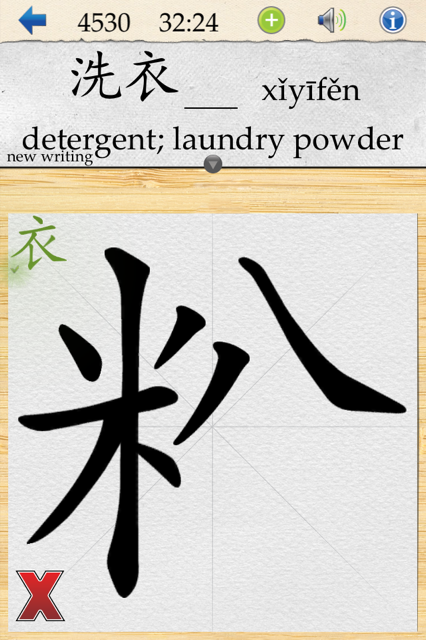
Before the official release of the app for iOS, I was approached by the Skritter team to test it, and perhaps write a review. I wasn't offered any freebies, and was given total freedom to write my own review, so I'm comfortable that this is a neutral perspective.
Also, while it was tempting to publish my review around the time of the official release when all those other reviews were being published, I was worried that I would write it more in light of my excitement of having a new novelty toy to play with. I was more keen to actually get a sense of the 'longevity' of Skritter for iOS ... how long before the excitement died down?? (Hint: It still hasn't)
For no particular reason, I'm going to write this review in the style of a FAQ. (By the way, if you are rushed for time, just read Q1, 4, 6, 7, 13. Oh heck, just read it all - this isn't a particularly long post :-)
1. Would you recommend Skritter iOS to others?
Yes
2. Will everyone benefit from using it?
In theory, yes. But I think there are plenty of Chinese learners who should be focusing more on pinyin, vocab acquisition, tones, and listening skills - and Skritter should perhaps wait a little longer.
3. What about the iOS experience?
From an iOS point of view, the implementation of Skritter is fantastic. It's sleek, artistic, fast, powerful, flexible. It's a great example of using iOS to the full.
4. Did you use Skritter before testing the iOS app?
No. In fact, I had a completely wrong idea about Skritter, so I never bothered before!
I'm glad I took the time to play with it. For example, I had assumed it was just about learning to write characters, but actually it's much more than that. Yes it can be used for that, but it has an amazing selection of vocab, so that it goes way beyond individual characters, into compound-words, phrases and sentences.
5. Does Skritter iOS cater nicely to people who haven't used the website before?
In some ways, Skritter is intuitive to use. But I think the team could do a little more to help people who are totally new to Skritter. For example, there are many settings in the preferences pane that I'm not sure what they actually do - a clarification sentence would be nice for each. It talks about numbers of items added, number of items synchronised, etc. - but it wasn't obvious to me what the difference is. I remember having to add characters one at a time, up to a hundred at a time, although I really wasn't sure why I was having to do that when I had already selected a list - shouldn't it just add the whole list?
6. For actually learning characters, would you recommend Heisig or Skritter?
I still believe that the Heisig method is a better way to learn characters (either reading or writing) than practising writing (on paper, in the air, or with Skritter). I strongly recommend that Heisig should come first, and then Skritter should follow. And yes, definitely use Skritter once you can read & write characters.
7. If you already can read/write through Heisig, why bother with Skritter?
Ah, well this is where I'm finding Skritter to be particularly amazing.
I believe Heisig is the best way to learn to read & write - certainly the fastest with least effort. But it doesn't teach you the pronunciation (pinyin), nor does it show you the characters being used in compound words. I'm finding Skritter to be an excellent bridge between the Heisig world, and the practical world of reading and writing more significant texts. Highly recommended.
8. What's your biggest concern about Skritter iOS?
I think I'll say it's the cost. I don't doubt that a huge amount has been invested in developing this great app, but at just under $10 per month, that's a huge investment, even over a year. I think a lot of people will be excluded from signing up at this price (even the discounted prices), and I'm curious to know whether I'll still be happy to be paying this before a year is up. In a world where apps cost a few dollars, this is on the other end of the scale.
I will say that the Skritter team are not trying to trick you to paying them money, though! As my trial period was ending, they sent me quite a few emails warning me that I was going to start getting charged. No one could claim they were charged because they forgot to cancel, by mistake. Well done Skritter.
9. Any technical thoughts about the app?
There are some strokes that Skritter keeps saying I'm wrong, even though I find myself writing perfectly over the hint-line, mostly commonly 阝 and many near-vertical lines. Odd. I'm inclined to believe it's my handwriting and not Skritter, but when my lines appear to overlap perfectly with the underlying hints, it makes me wonder.
10. Do you like the font that underlies Skritter?
Actually yes, it's a beautiful font - lovely. I do wish however that we were given the option of a second font - something that was a little more computer-perfect. Most of the characters I see are of course on a computer, and Skritter's font is slightly more stylistic. This means I find myself positioning/angling some of my strokes in ways I would expect based on what I see most of the time. From memory, characters like 火, 垂, 民 all are slightly different as a computer font than the Skritter font. This means either Skritter thinks I'm wrong at times, or it ends up moving my stroke far away from where I placed it. I can learn to live with just one Skritter font, but a less stylised one might be a nice option. One day.
11. What about Skritter as a flashcard app?
Well, it is sold as an SRS (spaced repetition system), but so far it doesn't feel like that. Maybe there is a setting I haven't used yet, but very few characters have come up a second time, I still seem to be working my way through the list, one phrase at a time. And although it tests my pinyin & tones & definitions, it feels like only 1 in 25 cards is non-handwriting. I'm still waiting for the 'repetition' to begin, let alone the 'spaced repetition'.
12. What extras would you like to see?
Firstly, I've simply added words from two lists: "Integrated Chinese 2" and "Business". And Skritter seems to have thrown these into a pot, deciding for itself which characters to feed to me when. Sometimes (particularly on a plane, flying somewhere for a business meeting) I feel like I'm in "business mode", and I'd like to learn words only from the Business list, but I can't do that.
Secondly, it would be nice to have a search facility. As I mentioned above, the character 垂 was different, if I remember correctly, to how it appears on the computer. But I can't search for a single character within Skritter in order to show you how it looks. Also, sometimes I remember struggling with certain characters, and it would be nice to find them again to practise, but I don't seem to be able to do that on the iOS app.
Thirdly, when trying to decide which lists to use, it would have been nice for the list description to include the number of characters that I'd be getting by selecting that list.
Fourthly, the app is really feature-packed, and it would not surprise me to find out that all the things I think need to change are already a part of the app - maybe I just don't know how to do it! :-) (For example, at one stage I thought a nice option would be to retain my stokes, rather than replacing them with the right strokes - but then I discovered there's a setting for that!)
13. In the opening paragraph you spoke about concern about the excitement of using Skritter iOS dying down ...
Yes, that was a real possibility. I've used many tools and websites to improve my Chinese; I've started listening to many podcasts - but over time I find I get bored of them, and just realise one day that I don't use them anymore. But so far Skritter has been really good, and I continue to enjoy using it. It's a nice distraction when I have a couple of minutes to spare, it's a nice break from podcasts, or Heisig Book 2. And I have definitely got value from using it.
So I am still using Skritter iOS. And I am still benefitting from Skritter iOS. And I am still happy to continue to pay for the Skritter iOS app.
tl;dr: If you can afford it, then I think you probably should use it too.
Write on!!
Showing posts with label SRS. Show all posts
Sunday, July 15, 2012
Friday, August 12, 2011
A clever butcher uses a cleaver
If you were learning English, then the above sentence might be a good one to stick in your flashcards. Picturing a butcher who wears professorial glasses, holding a cleaver, might make it easier - both visually and audio-wise - to remember the new word 'cleaver'. It's certainly more memorable then the sentence: "Use a cleaver to cut meat."
And this is the logic I've tried to use when finding new sentences to enter into my flashcard deck.
As you would have seen from my post a few months back about finding sentences, I use a variety of sources for my deck. But it was only when I was reviewing this sentence below, that I realised that there was a clever/cleaver trick that I was unconsciously using.
Lennie stopped chewing and swallowed it whole
Lúnní tíngzhǐ jǔjué, húlún yànle xiàqu
伦尼停止咀嚼,囫囵咽了下去
倫尼停止咀嚼,囫圇咽了下去
While saying the sentence during my daily flashcard revision, I realised that this sentence had a clever/cleaver style of repetition in the words 'Lúnní' and 'húlún'. It's not a big thing, but I realised it was a bit of a mental crutch that I had indeed being relying on when learning the cards - and on a few occasions when I was trying to recall a word in conversation.
I went back through some of my flashcards, and found that so many sentences I'd chosen had inadvertently used this trick, and I've actually tried to be more intentional in this regard.
OK, so now that you know this trick, there really is nothing else to say. If you choose not to take advantage of this, that's your choice. But if you choose to use this, here are some sentences that I've found in my deck which someone was clever/cleaver in constructing.
If you'd like to copy these into your deck, feel free ...
I fell asleep as soon as my head hit the pillow
wǒ tóu yi pèngdào zhěntou jiù shuìzháo le
我头一碰到枕头就睡着了
我頭一碰到枕頭就睡著了
trick: tóu / zhěntou (although, you really should have noticed this without clever/cleaver sentences!)
She sat there motionless, nothing can motivate her
tā yidòngbudòng de zuò zàinar, méiyǒushénme néng cùdòng tā
她一动不动地坐在那儿,没有什么能促动她
她一動不動地坐在那兒,沒有甚麼能促動她
trick: yidòngbudòng / cùdòng
If you lose a credit card you should report it to the police
diūshī xìnyòngkǎ yào xiàng jǐngchá bàoshī
丢失信用卡要向警察报失
丟失信用卡要向警察報失
trick: diūshī / bàoshī
Don't disappoint your parents
bùyào gūfù fùmǔ duì nǐde qīdài
不要辜负父母对你的期待
不要辜負父母對你的期待
trick: gūfù / fùmǔ
Mr Li the shopkeeper has two assistants
Lǐ lǎobǎn yǒu liǎng gè zhùlǐ
李老板有两个助理
李老闆有兩個助理
trick: Lǐ / zhùlǐ
And here are a number of other sentences that appear in my flashcards, but I'll leave you to do the translations yourself if you want to use them. The trick might be around using the same sound, the same character, or anything else that makes it easier to recall one word using another part of the sentence:
这是违法的行为
我花了一些时间决定花钱买哪种花
我们可以推断会议推迟了
我们铸蜡成烛
纤维 / 维生素
租约下个月到期
耳朵, 耳环, 耳机, 耳语, 耳子
个人开户账户申请表
每个透支的支票
对于妇女来说就业就会有牺牲
薪水会直接汇入你的帐户
这个座位很小坐得很不舒服
非工作人员禁止进入
他们企图蒙骗公众耳目 (cheat! sounds like 'qitu')
Just to be clear ... this is not a miracle. This will not take you from a beginner to intermediate in record time. But it will make it a little easier to remember words, and since you're already investing time in learning Chinese, you may as well take advantages of clever/cleaver tricks like this.
Don't butcher it!
And this is the logic I've tried to use when finding new sentences to enter into my flashcard deck.
As you would have seen from my post a few months back about finding sentences, I use a variety of sources for my deck. But it was only when I was reviewing this sentence below, that I realised that there was a clever/cleaver trick that I was unconsciously using.
Lennie stopped chewing and swallowed it whole
Lúnní tíngzhǐ jǔjué, húlún yànle xiàqu
伦尼停止咀嚼,囫囵咽了下去
倫尼停止咀嚼,囫圇咽了下去
While saying the sentence during my daily flashcard revision, I realised that this sentence had a clever/cleaver style of repetition in the words 'Lúnní' and 'húlún'. It's not a big thing, but I realised it was a bit of a mental crutch that I had indeed being relying on when learning the cards - and on a few occasions when I was trying to recall a word in conversation.
I went back through some of my flashcards, and found that so many sentences I'd chosen had inadvertently used this trick, and I've actually tried to be more intentional in this regard.
OK, so now that you know this trick, there really is nothing else to say. If you choose not to take advantage of this, that's your choice. But if you choose to use this, here are some sentences that I've found in my deck which someone was clever/cleaver in constructing.
If you'd like to copy these into your deck, feel free ...
Bees store honey to get through winter
mìfēng wèi guòdōng zhùcún fēngmì
蜜蜂为过冬贮存蜂蜜
蜜蜂為過冬貯存蜂蜜
trick: mìfēng vs fēngmìI fell asleep as soon as my head hit the pillow
wǒ tóu yi pèngdào zhěntou jiù shuìzháo le
我头一碰到枕头就睡着了
我頭一碰到枕頭就睡著了
trick: tóu / zhěntou (although, you really should have noticed this without clever/cleaver sentences!)
She sat there motionless, nothing can motivate her
tā yidòngbudòng de zuò zàinar, méiyǒushénme néng cùdòng tā
她一动不动地坐在那儿,没有什么能促动她
她一動不動地坐在那兒,沒有甚麼能促動她
trick: yidòngbudòng / cùdòng
If you lose a credit card you should report it to the police
diūshī xìnyòngkǎ yào xiàng jǐngchá bàoshī
丢失信用卡要向警察报失
丟失信用卡要向警察報失
trick: diūshī / bàoshī
Don't disappoint your parents
bùyào gūfù fùmǔ duì nǐde qīdài
不要辜负父母对你的期待
不要辜負父母對你的期待
trick: gūfù / fùmǔ
Mr Li the shopkeeper has two assistants
Lǐ lǎobǎn yǒu liǎng gè zhùlǐ
李老板有两个助理
李老闆有兩個助理
trick: Lǐ / zhùlǐ
And here are a number of other sentences that appear in my flashcards, but I'll leave you to do the translations yourself if you want to use them. The trick might be around using the same sound, the same character, or anything else that makes it easier to recall one word using another part of the sentence:
这是违法的行为
我花了一些时间决定花钱买哪种花
我们可以推断会议推迟了
我们铸蜡成烛
纤维 / 维生素
租约下个月到期
耳朵, 耳环, 耳机, 耳语, 耳子
个人开户账户申请表
每个透支的支票
对于妇女来说就业就会有牺牲
薪水会直接汇入你的帐户
这个座位很小坐得很不舒服
非工作人员禁止进入
他们企图蒙骗公众耳目 (cheat! sounds like 'qitu')
Just to be clear ... this is not a miracle. This will not take you from a beginner to intermediate in record time. But it will make it a little easier to remember words, and since you're already investing time in learning Chinese, you may as well take advantages of clever/cleaver tricks like this.
Don't butcher it!
Labels:
flashcards,
learn-chinese,
mandarin,
sentences,
SRS,
vocabulary
Sunday, July 31, 2011
How many flashcards does it take to change a lightbulb?
Some people do it daily (some people wish they did it daily!), and others only do it infrequently, or even never.
For me, spending time on flashcards has become an (almost) daily routine. I have recently already written that you should just do it, about how effective it has been for me, and to tell you how to test whether you should be using flashcards - so take a look if you haven't seen those articles.
In this next in the series, I wanted to go personal (yes, even more personal than writing about my love affair - In fact, I'm going to let you look into my actual set of flashcards, through sample sentences, numbers & dates.
Deck Statistics
Anki has a feature which gives you a whole bunch of facts about your specific deck. Here are some of mine, covering the deck itself, as well as how I've used it.
total numbers
From humble beginnings ...
I think you'll agree that I've improved my skill level over the last two years! And don't let this mislead you ... I don't know all the latest ones. For example, I recently needed to know the word 'loose' while talking to someone and realised I didn't know how to say that. So I looked it up in the dictionary, found a good sentence, and entered it into my deck. A few weeks will pass before this sentence comes up to the top of the pack, and then I will 'learn' it through spaced-repetition.
So that's me
If you'd like to share some of your desk statistics, I'd love to see them - whether you're a beginner or really advanced.
Most interestingly, I would love it if you could leave a comment below to say what your first few words were, what your most recent entries are, and what the time period is in between.
And if you've just started a deck of your own, perhaps since reading this series on flashcards, let us know what your first few entries have been.
For me, spending time on flashcards has become an (almost) daily routine. I have recently already written that you should just do it, about how effective it has been for me, and to tell you how to test whether you should be using flashcards - so take a look if you haven't seen those articles.
In this next in the series, I wanted to go personal (yes, even more personal than writing about my love affair - In fact, I'm going to let you look into my actual set of flashcards, through sample sentences, numbers & dates.
Deck Statistics
Anki has a feature which gives you a whole bunch of facts about your specific deck. Here are some of mine, covering the deck itself, as well as how I've used it.
total numbers
- deck created 2.1 years ago
- total number of 'facts' is 1530 (a fact contains english, pinyin, simplified hanzi and (sometimes) traditional hanzi too)
- total number of cards is 3680 (in the early days, a fact only generated two cards: english-to-pinyin & pinyin-to-english; but after a while I extended it to three: english-to-pinyin/simplified/traditional, simplified-to-english/pinyin/traditional, pinyin-to-english/simplified/traditional)
- according to Anki, 76% of my cards are 'mature' (I've basically seen these often enough that they're 'known', 6% are 'young' (I'm currently actively working through them), and 18% are unseen.
- In the last week I did 500 cards, averaging about 70 a day. According to Anki, I missed one day in the last week.
- My average over the last 3 months is 45 cards a day, and over the last year is 52 cards a day.
- Since the deck was created, I have averaged 53 cards a day, and used Anki just under 5 days a week.
- Since the beginning, I have added less than 5 cards a day, but this has only been around 2 a day in the last year. (Remember that by entering a single 'fact' Anki automatically generates a number of 'cards' - so I would say this averages about 2 new physical entries a day, that's all.)
From humble beginnings ...
- The first six entries in my deck are: (know / zhīdào / 知道), (formal / zhèngshì / 正式), (about / guānyú / 关于), (accept,approve / tóngyì / 同意), (after / zhīhòu / 之后), (agree / shuōhǎo / 说好).
- The six latest entries are:
- profit commission adjustment request / 盈佣调整询问函
- There were a lot of groupies at the Michael Jackson concert in Japan / 迈克尔·杰克逊在日本的演唱会招来了许多追星族
- to accumulate over a long period of time / 日积月累
- Unless you say it so that your word becomes another, then it's no problem / 除非你说的词变成另外一个词,否则没问题
- tomorrow;daybreak / 明天;天明
- You have to tighten up the handle, it has become loose / 柄松动了,你得把螺丝拧紧
I think you'll agree that I've improved my skill level over the last two years! And don't let this mislead you ... I don't know all the latest ones. For example, I recently needed to know the word 'loose' while talking to someone and realised I didn't know how to say that. So I looked it up in the dictionary, found a good sentence, and entered it into my deck. A few weeks will pass before this sentence comes up to the top of the pack, and then I will 'learn' it through spaced-repetition.
So that's me
If you'd like to share some of your desk statistics, I'd love to see them - whether you're a beginner or really advanced.
Most interestingly, I would love it if you could leave a comment below to say what your first few words were, what your most recent entries are, and what the time period is in between.
And if you've just started a deck of your own, perhaps since reading this series on flashcards, let us know what your first few entries have been.
Labels:
flashcards,
learn-chinese,
mandarin,
sentences,
SRS,
statistics,
vocabulary
Sunday, July 3, 2011
My long romance with flashcards
In my previous post on the topic, I recommended very strongly that you should be using flashcards as part of your Chinese-learning efforts.
In this post I'd like to write a bit about how my relationship with flashcards has gone, and why I find it one of the most useful tools available to progress one's learning.
SRS
When I started with flashcards, I used a program that was not SRS-based, which was a terrible mistake. A random-card system was fine in school when you were trying to revise the capital cities of the world, but not when you're using it as a tool to learn Chinese words. I would learn a word, and then it wouldn't appear again for weeks, by which time I'd have to learn it again. Or words that I already knew well would keep coming up - wasting my time. So I gave up on flashcards.
But it wasn't long after that I found Anki, which felt so natural that I haven't stopped using it since then.
Setting it up
Some people load up pre-made decks when they begin - for example there are beginner's Chinese packs available that you can you download directly into Anki. However in my case, there were just a few dozen words that I wanted to learn (or so I thought!), so I chose to set up my own deck and start with only words that I cared about.
I built three fields for each 'fact': English, pinyin, simplified Chinese. And for each 'fact', I built two 'cards' - one where the English was the question, and pinyin & Chinese were the answer; and one where pinyin was the question and English & Chinese were the answer.
To be honest, I didn't even look at the Chinese writing, I was a beginner and I stuck with English & pinyin.
Phrases & Sentences
Over time, knowing individual words wasn't enough. I needed to use sentences, and frankly my grammar was rubbish. Some of the words I was adding were coming from the About.com daily words email, and ever-practical I realised it would take just as long to copy a word into my deck as to copy a sentence - and thus it began.
Again, although my deck is made up of words & sentences that I have added myself, you can choose to take the route of downloading a pre-made deck directly into Anki, one of which is called "20,000 Chinese Sentences". Whatever works for you.
I slowly got into Chengyu (I've written about that guilty pleasure before) and have also added a few into my deck over time.
(Here are two screenshots [1] [2] of cards from my deck, if that helps give you context.)
Relevance
To make sure that I was learning words that I would be likely to use in future, whenever I looked up a word in my dictionary, and I felt that I really wanted to remember it, it became automatic to copy that word into my deck too. Took just a few seconds to make another card.
(See "Why a meal is worth more to me than my grandmother" for more thoughts on sticking to relevant learning.)
Earlier on I was just copying the word (including English, pinyin & Chinese), but over time I made sure that I found a sentence that used the word. This gave the word a context, made it easier to remember than just a lonesome word, improved my grammar, and sometimes included other useful words to learn too.
This use of sentences was so valuable to my learning that I wrote an article called Getting Sentenced in Mandarin, about how to track down good sentences.
I don't know if building up a deck from scratch sounds like a lot of effort, but if you're only doing a few a day, and since you're just copying & pasting, then it's really quick.
Do not let flashcards be your excuse. Do not spend so much time building up a deck that you never get around to using it to learn.
Chinese characters
Although I learned to recognise a few characters simply by virtue of the fact that my cards included the Chinese writing, this was incidental. It was only a couple of years ago, when I started to formally learn to read Chinese (here is Day 0 of that adventure) that I changed my flashcard practice. Instead of only using English or pinyin as the questions in Anki, I also set it to show me the Chinese version of the words & sentences I had already entered. In Anki, this change took about a minute to make - it's a great program.
And of course, having moved to Hong Kong late last year, I am now surrounded by traditional Chinese characters - but my deck was populated with simplified characters! Making some easy edits to my deck format, I added an extra field, and then any sentences that I added after that time would also get the traditional characters added too. I don't test myself based on the traditional characters, but I am still able to compare the two systems when looking at the card. And for now, that's enough.
Getting technical
More recently, rather than focusing on words from general conversation, I'm taking the time to build up vocab that I am likely to hear in meetings, or read in documents. Since I'm in the financial sector, these words include things like: assets, credit rating agency, cost of capital, assess, reserves, medical insurance, etc.
The process is the same as I've been doing - I find a word I want to learn, look it up, explore sentences of the various results to make sure I've got the right word in the right context, and then copy it into my deck. Usually it takes a few days or a few weeks before that new entry makes it into the queue for me to start learning.
So that's it for me and deck. I would love to hear about you and yours ...
In this post I'd like to write a bit about how my relationship with flashcards has gone, and why I find it one of the most useful tools available to progress one's learning.
SRS
When I started with flashcards, I used a program that was not SRS-based, which was a terrible mistake. A random-card system was fine in school when you were trying to revise the capital cities of the world, but not when you're using it as a tool to learn Chinese words. I would learn a word, and then it wouldn't appear again for weeks, by which time I'd have to learn it again. Or words that I already knew well would keep coming up - wasting my time. So I gave up on flashcards.
But it wasn't long after that I found Anki, which felt so natural that I haven't stopped using it since then.
Setting it up
Some people load up pre-made decks when they begin - for example there are beginner's Chinese packs available that you can you download directly into Anki. However in my case, there were just a few dozen words that I wanted to learn (or so I thought!), so I chose to set up my own deck and start with only words that I cared about.
I built three fields for each 'fact': English, pinyin, simplified Chinese. And for each 'fact', I built two 'cards' - one where the English was the question, and pinyin & Chinese were the answer; and one where pinyin was the question and English & Chinese were the answer.
To be honest, I didn't even look at the Chinese writing, I was a beginner and I stuck with English & pinyin.
Phrases & Sentences
Over time, knowing individual words wasn't enough. I needed to use sentences, and frankly my grammar was rubbish. Some of the words I was adding were coming from the About.com daily words email, and ever-practical I realised it would take just as long to copy a word into my deck as to copy a sentence - and thus it began.
Again, although my deck is made up of words & sentences that I have added myself, you can choose to take the route of downloading a pre-made deck directly into Anki, one of which is called "20,000 Chinese Sentences". Whatever works for you.
I slowly got into Chengyu (I've written about that guilty pleasure before) and have also added a few into my deck over time.
(Here are two screenshots [1] [2] of cards from my deck, if that helps give you context.)
Relevance
To make sure that I was learning words that I would be likely to use in future, whenever I looked up a word in my dictionary, and I felt that I really wanted to remember it, it became automatic to copy that word into my deck too. Took just a few seconds to make another card.
(See "Why a meal is worth more to me than my grandmother" for more thoughts on sticking to relevant learning.)
Earlier on I was just copying the word (including English, pinyin & Chinese), but over time I made sure that I found a sentence that used the word. This gave the word a context, made it easier to remember than just a lonesome word, improved my grammar, and sometimes included other useful words to learn too.
This use of sentences was so valuable to my learning that I wrote an article called Getting Sentenced in Mandarin, about how to track down good sentences.
I don't know if building up a deck from scratch sounds like a lot of effort, but if you're only doing a few a day, and since you're just copying & pasting, then it's really quick.
Do not let flashcards be your excuse. Do not spend so much time building up a deck that you never get around to using it to learn.
Chinese characters
Although I learned to recognise a few characters simply by virtue of the fact that my cards included the Chinese writing, this was incidental. It was only a couple of years ago, when I started to formally learn to read Chinese (here is Day 0 of that adventure) that I changed my flashcard practice. Instead of only using English or pinyin as the questions in Anki, I also set it to show me the Chinese version of the words & sentences I had already entered. In Anki, this change took about a minute to make - it's a great program.
And of course, having moved to Hong Kong late last year, I am now surrounded by traditional Chinese characters - but my deck was populated with simplified characters! Making some easy edits to my deck format, I added an extra field, and then any sentences that I added after that time would also get the traditional characters added too. I don't test myself based on the traditional characters, but I am still able to compare the two systems when looking at the card. And for now, that's enough.
Getting technical
More recently, rather than focusing on words from general conversation, I'm taking the time to build up vocab that I am likely to hear in meetings, or read in documents. Since I'm in the financial sector, these words include things like: assets, credit rating agency, cost of capital, assess, reserves, medical insurance, etc.
The process is the same as I've been doing - I find a word I want to learn, look it up, explore sentences of the various results to make sure I've got the right word in the right context, and then copy it into my deck. Usually it takes a few days or a few weeks before that new entry makes it into the queue for me to start learning.
So that's it for me and deck. I would love to hear about you and yours ...
Labels:
Anki,
flashcards,
learn-chinese,
mandarin,
spaced repetition,
SRS,
vocabulary
Friday, July 1, 2011
Flashcards: just do it
There's a lot of debate about whether you should use flashcards for learning Chinese. And perhaps the advice I should give you is: Use it if it works for you, and don't use it if it doesn't work for you.
Simple.
But I should also state that I have benefited so massively from the use of flashcards, that I really believe you should use it - regardless of whether you think it might be useful or not.
Just do it.
My use of flashcards has evolved over the years, and that's probably why I'm still getting value out of them, starting with individual words (excluding Chinese characters), progressing through to much more complex sentences which include the hanzi.
I use Anki, which is an SRS (spaced repetition system) program that runs on most operating systems. It's incredibly intuitive, very flexible, and free. You may as well install it now, if you haven't already done so, and you can learn more about how to use it optimally in the next few posts I write.
One of the more common arguments against using flashcards is that if you are reading books & newspapers & websites in Chinese, then you will end up learning the most common words anyway, without wasting your time on words that you might almost never see.
But most students of Chinese are not at that level, and therefore most students really should be focusing on accumulating words as quickly as possible. The more words you know, the more you will understand and the more you will be able to say. A flashcard system is, in my opinion, the best way to get there.
So if you're an advanced student, flashcards might not be for you. But for anyone else ... Just do it.
Simple.
But I should also state that I have benefited so massively from the use of flashcards, that I really believe you should use it - regardless of whether you think it might be useful or not.
Just do it.
My use of flashcards has evolved over the years, and that's probably why I'm still getting value out of them, starting with individual words (excluding Chinese characters), progressing through to much more complex sentences which include the hanzi.
I use Anki, which is an SRS (spaced repetition system) program that runs on most operating systems. It's incredibly intuitive, very flexible, and free. You may as well install it now, if you haven't already done so, and you can learn more about how to use it optimally in the next few posts I write.
One of the more common arguments against using flashcards is that if you are reading books & newspapers & websites in Chinese, then you will end up learning the most common words anyway, without wasting your time on words that you might almost never see.
But most students of Chinese are not at that level, and therefore most students really should be focusing on accumulating words as quickly as possible. The more words you know, the more you will understand and the more you will be able to say. A flashcard system is, in my opinion, the best way to get there.
So if you're an advanced student, flashcards might not be for you. But for anyone else ... Just do it.
Labels:
Anki,
flashcards,
learn-chinese,
mandarin,
spaced repetition,
SRS,
vocabulary
Subscribe to:
Posts (Atom)


