Showing posts with label art. Show all posts

Thursday, January 2, 2014

Don't read books, read sculptures

Firstly, happy new year - welcome to 2014!   Secondly, just a quick post about something I saw which I thought was totally amazing …


Zheng Lu is an artist who creates very impressive things - you can see his full collection here. But it was in particular a series of sculptures made up of thousands of Chinese characters that really caught my eye.

The article which talks about these can be found here, it's well worth a look. And to give you a sense of scale, take a look at the picture above, and you can see the most incredible detail Zheng Lu goes to in his work.

So if you're tired of practising reading Chinese books, and you'd like to read something a little different, then read that!

Monday, October 1, 2012

Chinese characters, or art?

I popped across the border from HK to China a couple of weeks ago (I have a multi-entry visa, so I may as well use it!), and happened to see a couple of really clever stylised Chinese characters that felt more arty than just characters - certainly very cleverly put together.


The first one I took off the side of a box of tissues - which in itself is pushing the boundaries of what qualifies as art! Take a look ...
To my rather untrained eye, it looks like this character:  (wēi) - which has a dictionary definition of "power / might / prestige", and a Heisig keyword of 'might'.   I actually think it's quite beautifully done!


This is the second character I saw, at the China Ferry Terminal building:
This one was easier to identify, being  (hǎi) - meaning "sea / ocean / maritime".  I left the full picture in, so you can see it is the logo for the Marine Department.  The water radical on the left has been replaced by a stream of water, and the 母 (mother radical) has been made to look like a flag - which suits what it is designed to represent.


These are not the first times I've seen characters written up so artistically, but this time I happened to take pictures of them. If you have seen other characters done unusually, please include links below ...

Thursday, May 24, 2012

Bad Heisig images & great Dali paintings

Discovering (un)treasure

It was about 2.5 years ago that I finished studying Book 1 of  "Remember the Simplified Hanzi" Heisig & Richardson. And as you might have seen from a relatively recent post, I've got Book 2 staring at me from the shelf ... but first I wanted to completely re-do Book 1, to make sure that I revised all primitive images, and was truly ready for the next installment.

In order to revise the book, I downloaded the Anki database of the book's 1500 characters, set it to 10 new characters a day, and just ran it from there. That happened nearly 150 days ago ... So I'm just a few dozen characters away from finishing the book. Again.

The database is pretty good, with the character number, hanzi, keyword, pinyin ... and it also contains stories (where Heisig & Richardson didn't provide their own stories). These stories appear to have been taken from a community effort to create stories for those characters that didn't get their own in the original book. I guess anyone would have been able to contribute their own story for a character, although I'm not sure how they chose which was the one to get into the Anki database.

Much of the time, I just stuck the the story that I had previously created myself, but every now and then I couldn't remember mine, so I looked at their stories. Some were actually quite good, but so often the stories left me scratching my head.

"The Persistence of Memory"

In this article, I have taken an extract of stories that I found in that Anki pack, and highlighted some of the ones that I don't like.

Of course, for the most common characters, you see them so often that after a while you forget the story and you just know the character. And that's OK. But there are some characters which I have barely seen since completing the book, and when I do see them sometimes, I do have to rely on the stories - and that's when the persistence of memory becomes important.

And this is going to be even more important for Book 2, I'm sure, given the even further reduced frequency of those characters.

This is not about personal preference of whether it's 'nice' - this is based on my being able to work through Book 1 in about 3 months, and seeing what did & didn't work. It's also based on now revising the book after 2.5 years, and noting which of my stories persisted, and which completely failed me after all this time.

No offense intended

It's possible that you were the author of one of the stories I have included below. No offense. But I think it might be useful to consider what makes a good story, and what is likely to give problems. And for anyone that thinks I've got it totally wrong, please leave some comments below ... I promise I won't be offended :)


The Hall of the (in)famous


760: 微: Tiny
The tiny sherpa (taskmaster) is leading this queue of brave ant mountaineers up the wall of the house and towards the ceiling where they can live in peace and security in the attic. Unfortunately, they didn't account for the strong winds that blow through the attic at that altitude, so they are all swept off the mountain (a wall) and back to the ground!

Two thinks go wrong, in my opinion:  Firstly, the story has too many 'equivalents' to be memorable: You have to remember that taskmaster is a sherpa (which may differ from your other taskmaster images), and a wall is a mountain - so when you see the image in your mind, will you remember to use a mountain? Or will the image of 'wall' arise and confuse you?  Secondly, there are too many extra words here, that are likely to confuse: house, ceiling, ground. These all have their own primitives, and this interferes with how the image persists in your memory.


950: 碌: Commonplace
Stones are commonplace - stone snowmen, less so!

Unlike the story for 'tiny', this one is simple with no additional confusing words. Good. But consider these two alternatives ...
 - Metal is commonplace - metal snowmen, less so!
 - Wood is commonplace - wooden snowmen, less so!

As you can see, although going from story to keyword might be possible, if you go from keyword to story, suddenly the requirement that the word is 'stone' fades, and you may not be able to remember what is the primitive on the left. Try to make the 'stone' more integral to the story.


951: 争: Contend
This drunkard has to contend with crossing a booby trapped lawn back to his house. First, he keeps stepping on rakes in the grass (which fly up and hit him in the face) and secondly he has to avoid getting bound up in the tough hedges all around.

Again, lots of extra words in the story to confuse which primitives should appear, like house & grass (which have their own primitives). Secondly, do you think you'll remember the word 'contend' when seeing the character? Or will you see the 'bound' and the 'rake', see the guy sneaking through the garden, and wonder if the keyword is 'careful' or 'dangerous' or 'injury' or ... 'contend'????


991: 乏: Weary
Zorro has become world-weary, having seen one too many drops of cruelty in his adventures.

This feels like a sentence and not an image. How do you visualise this? Will you still have memorised the phrasing of this sentence in two years time?   "drop of cruelty"?  I just believe that stories should be more clear, more explicit, less wordy, for them to persist in memory.


1036: 泻: Diarrhea
Diarrhea flows out like water, writing off the meal that you ate last night.

Yes the primitive on the right is 'writing', and in theory 'writing off' matches that. But as with the previous story, this would only work if you memorise the sentence. It's not an image, and it's unlikely to be remembered for long enough to be useful. I would really recommend your image either includes someone writing, or seeing writing on a page ... something that is visually memorable. And try be consistent: if it's someone writing, then always see someone writing to represent that primitive.


1157: 饭: Meal
At mealtimes you eat your food against the backdrop of a TV episode or some other entertainment. Mealtimes are the only things that will drag you out of contemplation of that idea that has been eating you up!

I don't even know where to begin with the confusion this image creates. Again, it is built on being able to memorise a sentence ("drag you out" - rather than seeing something being dragged;  "against the backdrop" - rather than seeing something against something;  "eating you up" - rather than someone actually eating). You are making it really hard for yourself if your images are based on memorising sentences, rather than picturing images that stick in your mind.


1178: 脑: Brain
The brain is the only part of Fagan's flesh this is worth anything - every other part of his flesh is cruel, despicable and nasty - from his top hat down to the pit of his stomach.

Double-counting! On the left is 'flesh' and on the right is 'Fagan' - thats is enough for a story.  Yet this one also includes the components of 'Fagan' (being 'hat' & 'cruel') - which is confusing.


1212: 请: Invite
You invited a few friends round for some drinks at your house, but the words got out and telescoped out of control! Now you have a full blown house party going on, and none of your words are helping to move the resulting mound of grown-up flesh from the house.

I'm sure by this time you're seeing that certain problems keep arising. Firstly (yet again) we have too many words ... drinks, friends, house, etc. Careful these don't confuse the image when you have to piece it together yourself. And secondly, it feels like trying to memorising a sentence again!  "telescoped out of control"?  "mound of grown-up flesh"?   Even if you see a wild party in your image, how will your mind remember "telescoped out of control"?  Can't you actually put a telescope into the image?


1252: 陈: Exhibit
The museum is showing off the pinnacle of Eastern transportation development. Forget Hyundai and Toyota - the humble rickshaw is the most amazing invention that they are exhibiting!

This takes the use of 'pinnacle' and again makes it wordy, rather than visual. In my mind I always use an image of the top of a certain famous building in London as 'pinnacle' - and any scene that takes place here will be obvious to me to use that primitive on the left, simple. And if you're thinking of this story/image, how will you remember to use the word 'pinnacle', and not 'top' or 'peak' or anything else?


1275: 决: Decide
"You Decide" - at least, since the last king had his head cut off by a guilllotine! Of course, given how effective democracy has been it would have been wise in restrospect to keep the head on ice to make decisions for us when the politicans are caught up in squabbling. Alternatively, this pictures someone who can't decide between two model of guillotine: extra tall or extra sharp? While he waits his feet are getting frozen to the ground in the cold air.

There are actually two version here. The first one has the added confusion of a head (careful not to use it as a primitive), whereas the second has the ground, which also isn't one of the primitives in the image. I'm not sure the link to 'decide' in the first one is obvious enough to be memorable.


1318: 蚊: Mosquito
Mosquitos are principally found in Scotland, where the insects bother the highlanders to their hearts content.

Heart's content? So there is the heart primitive in the image? No, so careful about using the word 'heart' :-)  And how does this story help you differentiate between mosquitos? Flies? Birds? All could work as it appears - but only one is right. Make sure your image involves them sucking blood - so it's clear this is a mosquito and not a fly.


1343: 遗: Bequeath
Bequeathing your possessions to your children can be an expensive road to go down, due to inheritance tax. Much better to spend it all before you die!

I feel I'm repeating myself here, so I'll stop after this one.  You can't visualise "road to go down" - not in the way it has been used in this story. Really try to be more explicit about a road, like having all your expensive possessions lined up along the side of the road, so you are in effect bequeathing it to anyone who wants to help themselves to something.


A Better Way

Ultimately this article is just to get you to think about what makes a bad story, to make sure you don't make these common mistakes. Trust me - you want these stories to last!

Here are some of the other posts I have written on making great images, so that you can succeed in learning to read Chinese ...
With a clear set-up, images that do the right things (as per the links here), and which don't do the wrong things (as with the examples in this post), you are ready for visuals that will last, that will take advantage of the Persistence of Memory.


Good luck!  And let me know below if you disagree with my assessments - it would be interesting to hear from you. (And yes, you can even comment if you agree with my post!)

Monday, November 23, 2009

Using Modern Art to Learn Chinese

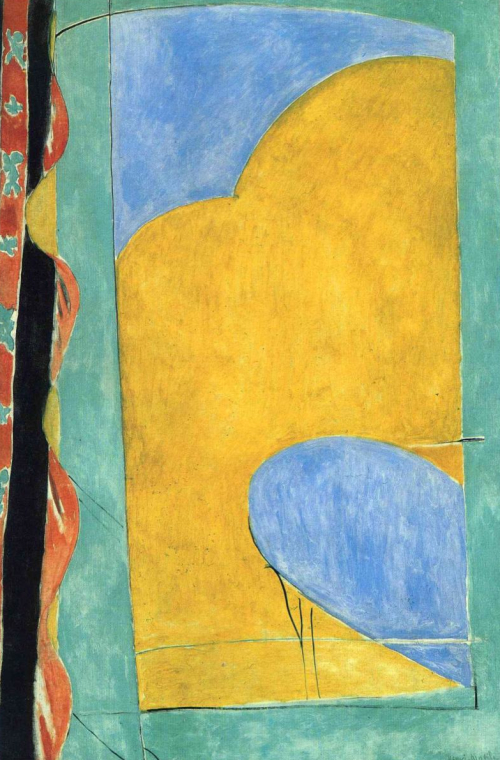
So I was sitting in the Tate Modern Art Gallery, staring at an abstract work by Henri Matisse. And the longer I stared at his "Yellow Curtain", the better my Chinese was getting.  It's amazing - almost unbelievable, in fact.

Actually, it's totally unbelievable. It never happened that way.  (And if you believe that it would work, you might be interested in a previous article called Learn to speak Mandarin fluently in 6 months.


But wait ...

Don't give up yet. In reality there is something about the way modern art is perceived by people that can improve how quickly you learn to read and write Chinese. In particular, I am referring to the Heisig method which allows you to use powerful visualisations that link the meaning of the word to the written components of the word which makes up the final character.

Some modern art is really abstract - in the picture above you can see a patch of yellow, and Matisse insists it's a yellow curtain. OK. I can live with that. And in fact, from now one, when I look at it ... I will think of a yellow curtain.

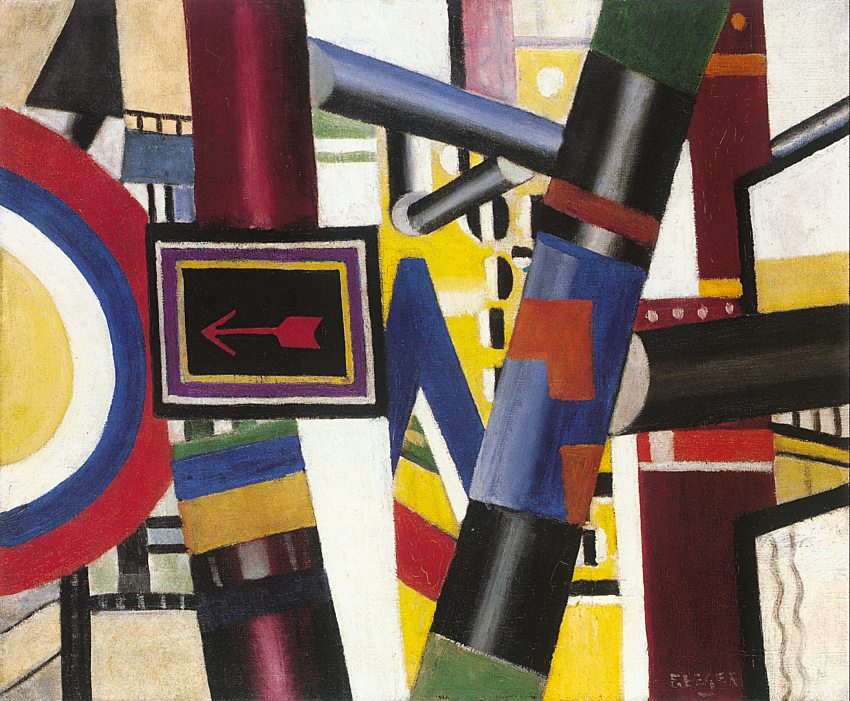
And other times you'll see just lines and blocks, which Leger has chosen to call "Railway Crossing". But this one is slightly different, because you might see little clues - like the sign with the arrow, and the concentric rings sign on the very left. For some people, especially people in France, this might be enough to trigger thoughts of a railway crossing.

And for people like me, I still don't get it. But I'll never forget the link again.

So if we take what we know about how artists can take an abstract image and allow it to create a special association; and if we use tricks like they do (for example, adding little Easter Eggs to the scene), we can greatly improve the way we memorise Chinese characters.


Seriously, but work with me on this ... 

I've blogged lots about Heisig already, but there is enough of a base of people using this method that I'd like to share some other tricks I use to speed up my learning, and improve my retention.

You might want to fill in the gaps (if any) by starting off reading my first Heisig post, then my three month update, then all the articles in between.

In memorising nearly 1500 characters in under 4 months, my ability to visualise images or stories has improved. Some approaches have worked, other techniques have failed. And with so many characters, you get pretty fast feedback. After all, if you can't remember a word the next morning, something failed!


Clear & Distrinct

Nouns are easy to memorise - especially nouns whose primitives are nouns too. You put together a series of objects to create another object.

For example, 汤 (tāng​) means 'soup'. It's made up of the primitives for 'water' and 'piglets'. Just picture a pot of boiling water where soup is being prepared, with screaming piglets trying to get out, and you have an image that you will not easily forget. Even if you want to!  (Sorry.)


Abstract

But other words are much more difficult to visualise, and therefore I seem to forget them more easily. Over the last few months, I've found some tricks that seem to have worked really well.

Below you will find some examples of the imagery I have used. You don't need to use the same images, but you might find the approach I've developed for myself useful to you.


Examples

  • Peace (安)
"I wrote about this one in a previous Tips & Tricks article , but it's a good example for getting the ball rolling.  'Peace' is hard for me to imagine without putting flowers into the image - which would then interfere with images that use a 艹 radical. So I thought of "Peaceful Sleep" which is a mosquito repellant I used plenty as a child, which plugs into the wall. I tried not to break the first rule of keeping things simple, but so that it was still useful. So with 按 (finger ... peace) I picture a finger pressing on the Peaceful Sleep device. (I don't imagine it's hot to touch, or that it's being switched on - or anything else which might confuse the image)."

  • Great (伟)

The primitives which make up this word are 'person' and 'briar patch'. (As an aside, because you typically have 'people' in so many of your images, Heisig cleverly suggests that you imagine someone specific, someone who doesn't appear in previous images.)

It's very difficult (... for me) to visualise a person walking through a briar patch, and at the same time create the image of 'great'. What does 'great' look like? So instead I have included in my image that this person finds a 'grate' between the briars - and is excited. I know this represents 'great' and not 'grate' - and I've never forgotten the word.

Additionally, it prevents me getting confused with the word for 'grand' ...

  • Grand (雄)

We piece together 'by your side', 'elbow' & 'turkey'. My image is of someone standing on a GRANDstand, watching a game for example. This person is holding a 'turkey' (I always visualise roast turkey, but a live one is fine :-), and suddenly someone 'elbows' them in their 'side', and they drop the turkey, watching it bounce down the stairs of the GRANDstand.

Again, in my mind, it's clear that the word is 'grand' and not 'grandstand'.

  • Appearance (样)

Creating an image that means 'appearance' isn't easy for me - maybe you have a great approach? The way I pieced together the two primitives (tree & sheep), is to see a sheep in front of a tree, improving it's 'appearance'. It is looking in a mirror, putting on lipstick, and straightening out it's wool. This works for me to associate with a word as "woolly" as 'appearance'.

  • Endure (忍)

This is another word which might be a little hard to visualise - even though the primitives (blade & heart) are easy to picture. In my case, I picture someone tied in a chair. They are being tortured, with a blade threatening to plunge into their heart. But they are 'enduring' - and not revealing their secret.

If you had a different image, please drop us a note - yours might be better than mine.

  • Deliberately (故)

I mentioned in my general article about improving your visualisation skills, that naughty themes can really help. Here's a less graphic example.

The primitives are 'ancient' & 'taskmaster' ('taskmistress', actually). The image I have created for 'taskmistress' is a woman in S&M leather gear - and this is an easy-to-remember image that is used consistently throughout, because it appears often.

So for this word, I can see a young attractive taskmistress, and a very old woman in the same clothing. (Naturally both of them are holding whips, but don't read between the lines - and don't assume you know anything about me and my tastes :-)  When the visitor chooses the older of the two, it's not just because the lighting is bad. The difference between these two women is too obvious - he must be choosing the ancient one 'deliberately'.

  • Border (边)

Again, this is a word which doesn't have definite form, and so is difficult to visualise - even though the primitives ('power' & 'road') are clear. My image is that on the 'road' ahead, there are a group of 'powerful' looking soldiers on duty - they are guarding the 'border' to stop the wrong people getting through. Can you see how tight those uniforms are? Awful.

  • Glory (荣)

There is a 'tree' which is so big it has grown through the roof of the 'greenhouse' - and the guy has won a prize for this work. He is getting all the 'glory' - ribbons, applause, and Gloria Estefan (yes, I can see it is her) is singing a congratulations song to him. As with 'great' (above) this is an addition I created to make sure I know it's 'glory' and not, for example, 'achievement'.

  • Achievement (功)

By picturing a 'powerful' person holding a very heavy 'I-beam' above his head, I am witnessing his 'achievement'. It's personal for him - no glory from an audience, and Gloria Estefan is not there to sing for his glory either. Achievement.

  • Temporary (暂)

The primitives are 'hew' (chop) and 'sun' (I don't use 'days', as you would have read previously). Of course no-one can chop an axe into the sun, but if they did - it would only be 'temporary' because very quickly the flames would close over the cut again. I can see the cut closing - can you?

  • Gradually (渐)

Similarly for 'water' and 'hew', I see someone chopping very gently & 'gradually' on the rocks, but the scene is set in the Great Canyon - which was formed slowly by millions of years of 'gradual' water erosion. That image is enough for me to link chopping, water & gradual.

  • Relatively (较)

I picture people 'mingling' amongst 'cars' in the parking lot. But oddly, the cars are lined up in size order from smallest to biggest, and the people are similarly mingling in size order. This scene allows me to see the 'relative' size of the cars & people, which is sufficient to make me remember 'relatively'.

As an added extra, in case I forget the keyword, it's also clear to me that the people are my relatives - which further helps remember the word 'RELATIVEly'. Note that I am careful that I don't let this addition confuse me with the word 亲 (relatives).


Go 'abstract' to get 'concrete'


These are some examples of imagery I have created. I can't guarantee they will work for you, and in fact you might have better ideas than me. I hope so!

So let me know what you've done. In particular, I'd like to see what scenes you used on the words above - I'm always looking for more 'concrete' ways of doing this. I'm only a few dozen from finishing the first 1500 characters, and Book 2 brings in another 1500 - so please comment generously.

Also, is there anyone else who hides little Eater Eggs, carefully selected additions, in their images to make recall easier? Let us have some examples ...